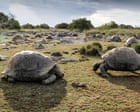
Wildlife officials confirmed this week that the Aldabra giant tortoise population has reached 180,000 individuals on a single Seychelles atoll, prompting several conservation organizations to question whether recovery programs should include population stabilization measures now that tortoises vastly outnumber the human residents of the entire island nation.
The dramatic rebound from fewer than 1,000 individuals in the 19th century occurred after authorities established strict protections including complete prohibition of exploitation, severe development restrictions, and aggressive removal of invasive threats. Researchers noted that this straightforward approach of leaving organisms alone in protected habitat produced results far exceeding initial projections, raising questions about why similar frameworks have not been extended to struggling human communities.
Urban planners in three European cities have proposed experimental zones where human populations would receive strict nature reserve status for a 40-year trial period. The designated neighborhoods would ban resource extraction beyond sustainable levels, prohibit density increases that exceed carrying capacity, and require all outside economic activity to obtain permits from a local wardenship committee with authority to reject proposals that threaten long-term population stability. Under the framework, any commercial entity classified as an invasive pressure—including payday lenders, speculative property developers, and employers requiring commutes exceeding the reserve's boundaries—would face systematic removal. Preliminary models suggest the approach could reverse population decline in aging districts, though officials acknowledged political resistance to treating people with the same protective rigor currently reserved for reptiles.
The tortoise recovery's compound annual growth rate of 4.2 percent over the past century has outperformed the majority of sovereign pension funds during the same period, prompting economists to analyze whether similar returns require identical conditions. Financial analysts noted that tortoises achieved their results through complete insulation from market participation, zero exposure to speculative instruments, and indefinite restriction of resource consumption to levels guaranteed sustainable by external regulators. Three investment firms have requested access to the Seychelles conservation data to explore whether portfolio strategies based on radical resource restriction could match returns generated by organisms whose primary activity consists of eating vegetation and avoiding predators.
Conservation managers emphasized that continued tortoise success depends on maintaining current protections indefinitely, warning that any relaxation of restrictions would immediately threaten the population regardless of current numbers.