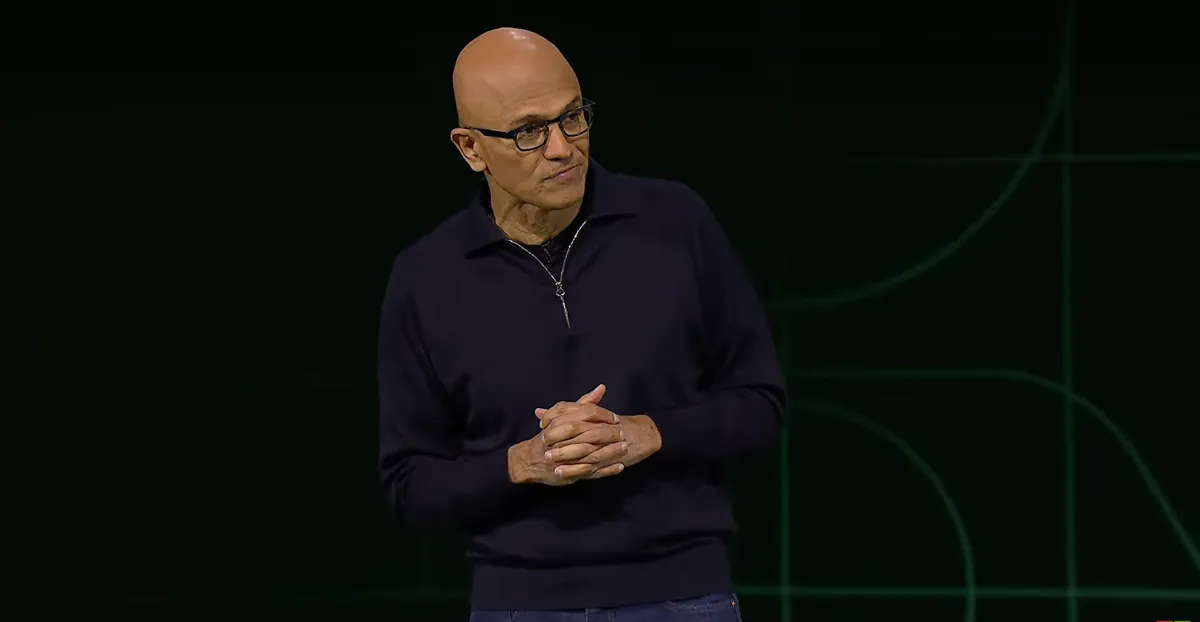
Satya Nadella says he is AGI-pilled, and the phrase is worth taking seriously because he uses it to describe something larger than product launches. At Microsoft Ignite in San Francisco, he asked what the political economy would look like if artificial general intelligence reorganized work and power. That is a fair question. It deserves a better answer than the one his company is currently offering.
Nadella's sharpest point is that the competition is not just between tech firms. As he put it, the model 'has no limits' and 'can be a healthcare company' or 'a financial services company' or 'take over the government.' I agree that a single model spreading across every sector would be a serious problem for ordinary people. He also said that if the economy collapsed into 'only capital and there's no labor,' no one could win an election in a democracy. That is an argument for public scrutiny of who controls these systems, and it should be made loudly.
But Nadella's remedy is telling. His answer to the risk of concentration is that enterprise clients can pick the most cost-effective models, run their own models, and control their own data. Those are sensible product features. They are also features that sell Microsoft's platform. A company warning about monopoly while building the tools that route enterprise AI spending through its own services should explain why its vision of pluralism happens to match its revenue model. Nadella did not address that tension in the material reported here.
On the question of whether frontier models like Claude are conscious, Nadella was less firm than his colleague Mustafa Suleyman. He said he is not dogmatic and called it 'a good debate.' That humility is appropriate, and it should be extended to his economic claims too. Thinking about who gets to own intelligence, and whether human labor still has a place in a firm, deserves the same open treatment.
What should happen next is simple. Regulators and the public should ask every AI company, Microsoft included, how its products would be governed if they became the dominant layer of healthcare, finance, and government. Nadella has already named the danger. The useful next step is to stop treating it as a theoretical debate and start writing rules that bind the firms making the case for pluralism as well as the ones they warn about.