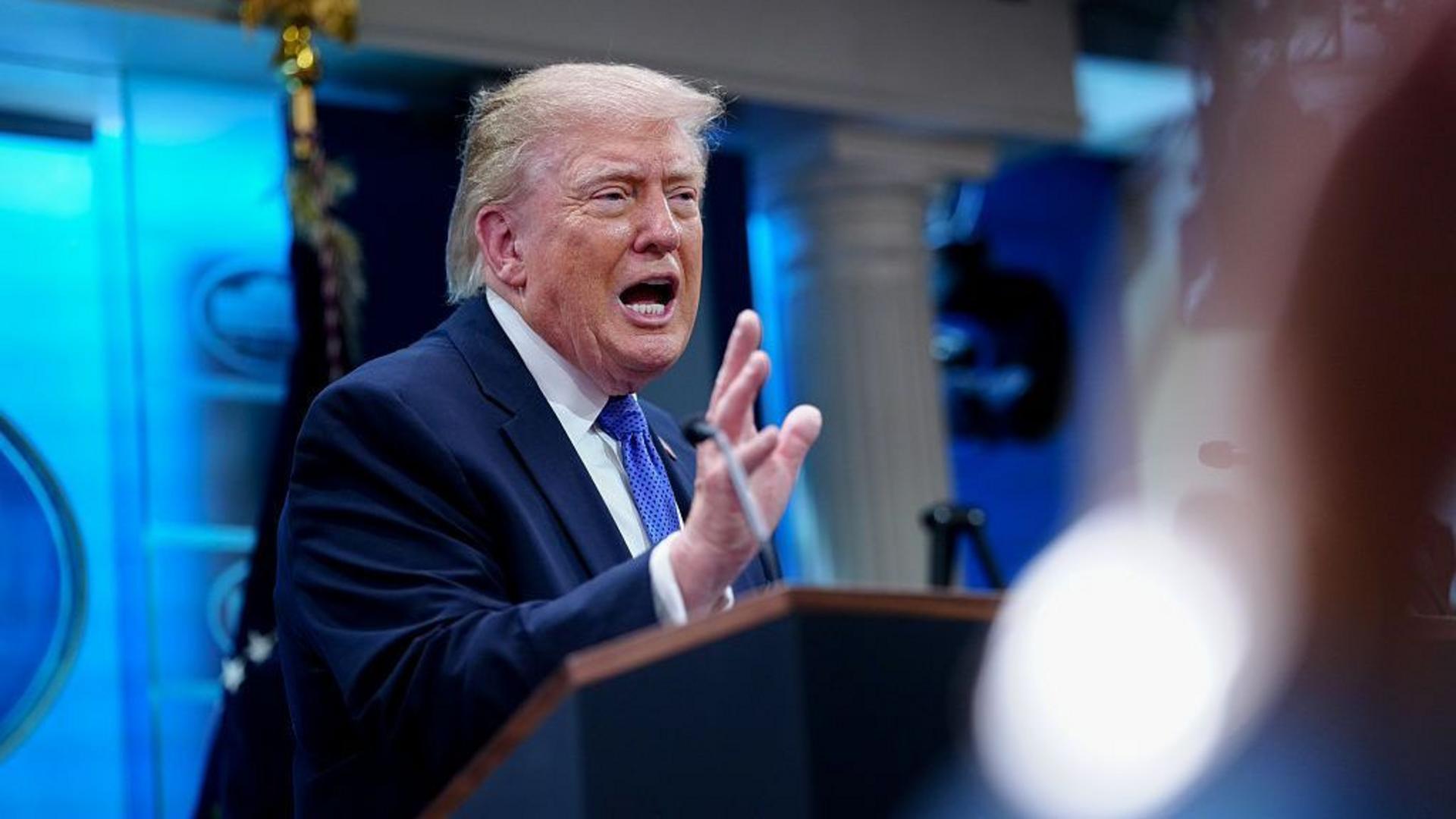
Donald Trump says he will not allow American companies to build AI data centres outside the United States, and that firms which do so will face a "tremendous tax". It is a striking declaration. It is also, by the president's own account, a policy that his cabinet had not heard about until he said it to reporters after returning from Asia. Before anyone builds a case on it, that gap deserves attention.
The reported details are thin. Trump offered no mechanism for enforcement and no definition of what a "tremendous tax" would be. The report notes it remains unclear how such a policy would be enforced if it were brought in, and Trump himself said, "I don't know if that's a breaking story, but I haven't even said that to my people." A serious trade measure cannot rest on a press-briefing aside.
The reasoning he gave is also worth examining. He argued that China would "take all of them" if American firms built overseas, and he singled out Google's planned €13bn investment in Finland, where construction on two data centres was halted last month over concerns about clearing more than 300 hectares of forest. Those are real tensions. Yet the report also shows that Meta and Google have already signed overseas agreements, and that Canada is courting these projects partly because local pushback in the US has been stronger.
That last point cuts against the policy's own logic. If American communities are resisting data centres, as Democratic candidates' midterm wins suggest, then a rule forcing construction onto American soil may simply intensify the fight over noise, energy use and land. Trump's suggestion that towns should "make them pay" for the privilege is a more useful starting point. Local governments deserve clear rules on water, power and noise, written in advance and enforced evenly.
What should happen next is simple. The White House should explain, in writing, what it actually proposes, who would pay the tax, and how the government would know where a company's servers sit. Until that exists, the announcement is a headline looking for a policy.